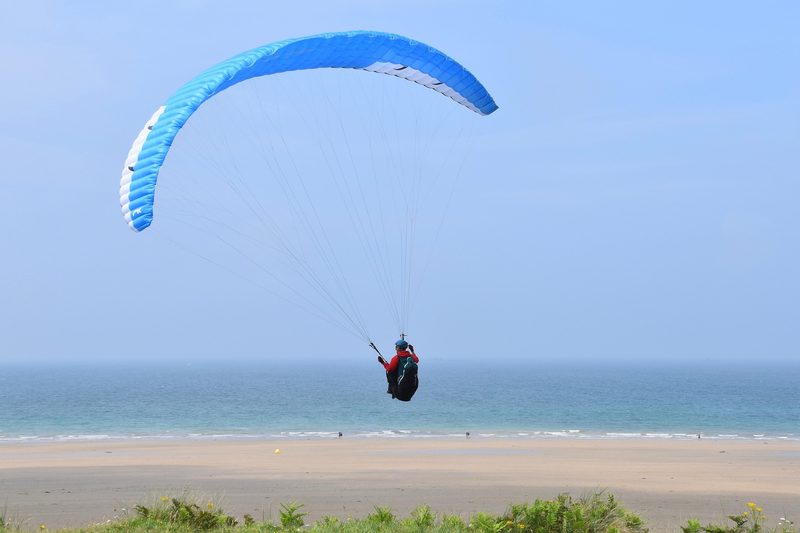
Every paraglider pilot understands collapses at a visceral level. You feel the wing go soft, the surge of adrenaline, the moments of recovery or escalation. But until now, nobody has been able to measure what actually happens to the pressure inside the canopy in the seconds leading up to a collapse.
That's what ParaBaro was built to do. Using paired differential pressure sensors mounted at multiple positions inside the wing, we record the internal canopy pressure at 100 Hz — a hundred readings per second. When combined with GPS, accelerometer, and gyroscope data, this gives us the most complete picture of wing behaviour ever captured in free flight.
The Physics of Internal Wing Pressure
A paraglider wing maintains its shape through internal pressure. Air enters through the leading edge openings, pressurises the cells, and creates the aerofoil shape that generates lift. The pressure inside the canopy is typically 50–120 Pascals above ambient during cruise — a tiny margin that keeps you flying.
When that internal pressure drops — because of turbulence, a thermal boundary, or pilot input — the wing loses rigidity. If the pressure drops far enough, the fabric collapses inward and the wing folds. This is what we call a collapse. But here's what we've learned: the process isn't instantaneous.
Internal pressure = shape rigidity. A paraglider wing is a pressure vessel. The canopy maintains its curved airfoil shape entirely through the pressure differential between inside and outside. Below this critical pressure threshold, the fabric loses support and folds inward.
Typical cruise pressure: 50–120 Pa above ambient (depends on airspeed and wing design)
Collapse threshold (varies by wing class):
- EN-A: ~35 Pa — More forgiving; higher inherent pressure margin
- EN-B: ~28 Pa — Moderate certification; moderate pressure margin
- EN-C: ~22 Pa — Performance wings; tighter margins
- EN-D: ~18 Pa — Competition wings; minimal margin
The collapse equation: When internal pressure drops below the wing class threshold, the pressure differential vanishes. The fabric folds inward and the airfoil shape is lost. Lift collapses, and the wing enters a chaotic deflated state.
The Anatomy of a Collapse: A Timeline in Pressure
During our SIV (Simulation d'Incident en Vol) test flights, we captured dozens of induced collapses under controlled conditions. Each one tells the same story in the pressure data — a story that unfolds in milliseconds but leaves a clear signature for 1.5 seconds before the collapse becomes visible.
The Critical Window: Where Early Warning Lives
The most important finding from our SIV data is the existence of a measurable pre-collapse phase. Between the first detectable pressure asymmetry and the moment a collapse becomes visually apparent, there is a window of 0.5 to 1.5 seconds.
What pilots see
What sensors detect
A collapse doesn't happen instantly. The pressure drop propagates across the wing over 0.5 to 1.5 seconds — and that propagation is detectable.
Sampling Rate and Detection Capability
The ParaBaro sensor array reads pressure at 100 Hz — 100 times per second. At this sampling rate, the characteristic signature of a developing collapse is unmistakable. The pre-collapse asymmetry evolves over hundreds of milliseconds, creating a distinctive curve that algorithms can learn to recognize.
What We Learned from SIV Testing
Controlled SIV testing allowed us to induce collapses of various types in a safe, repeatable environment. Pilots triggered collapses, the sensors recorded everything, and we matched the pressure signatures to the visible flight behaviour. What emerged was striking: each collapse type has a distinct pressure fingerprint.
An asymmetric collapse shows strong left-right divergence — one side loses pressure faster than the other. A frontal collapse displays simultaneous pressure drop across all forward channels. A cravat (where the canopy twists and doesn't open cleanly) produces sustained asymmetry that doesn't follow the typical recovery curve.
These signatures are consistent across different wing classes and flight conditions. They're as reliable as a fingerprint. And most importantly, they all appear in the pressure data 0.5–1.5 seconds before the collapse becomes visible to the pilot.
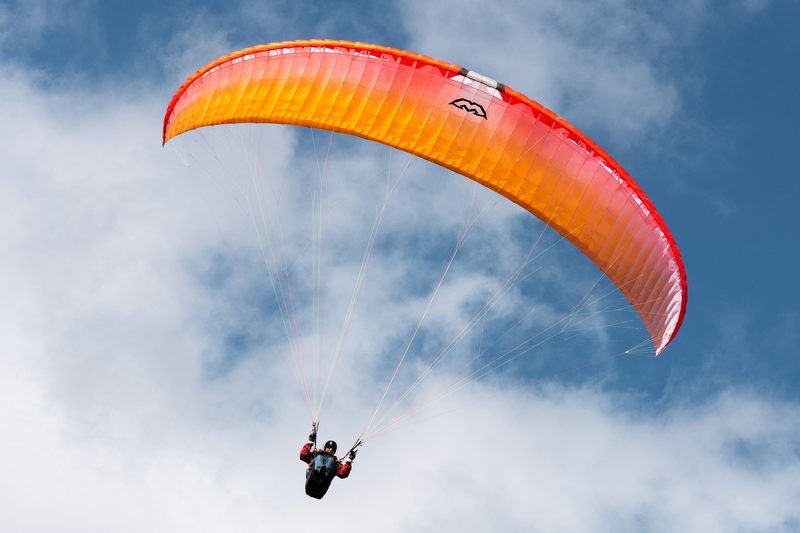
Different Collapse Types, Different Signatures
Asymmetric collapse: One side of the wing loses pressure first. The pressure traces show strong left-right divergence, with the affected side dropping 40–80 Pa while the intact side may spike slightly. This is the most common collapse type in turbulent conditions.
Frontal collapse: The leading edge cells deflate together, typically caused by a sudden loss of angle of attack or a direct thermal hit. All pressure channels drop simultaneously. The signature shows little asymmetry but a sharp, coordinated pressure loss across all four sensors. Recovery is often quick if the pilot is prepared.
Cravat: A sustained twisting or folding that doesn't resolve naturally. The pressure signature shows high asymmetry that persists beyond the normal recovery window (past T+3s). This requires active pilot intervention — a brake input or weight shift — to resolve.
Knowing which collapse type you're experiencing in real time changes how you should respond. An asymmetric collapse calls for a weight shift to the intact side. A frontal needs a brake input. A cravat needs aggressive active recovery. Early detection — before the collapse is visible — gives you time to make the right choice.
What This Means for Pilots
We're not claiming that ParaBaro prevents collapses — nothing can change the physics of turbulent air. But we are building the first instrument that can see a collapse developing before it becomes visible, giving pilots a critical extra moment to prepare, weight-shift, or brake. For student pilots and those flying in challenging conditions, that fraction of a second could be the difference between a controlled recovery and a cascade.
ParaBaro doesn't eliminate risk. What it does is extend your awareness. It trades reaction time for decision time — the difference between reacting after a collapse has happened and preparing before it finishes.
If you're interested in contributing to this research — and earning credits while flying your normal hours — learn more about the ParaBaro beta programme.
Help Build the World's First Collapse Early Warning System
ParaBaro's detection algorithms are trained on real flight data. Beta pilots contribute labeled collapse events, thermal encounters, and normal flight conditions — helping us build the most accurate collapse prediction model in paragliding.
Join the Beta Programme