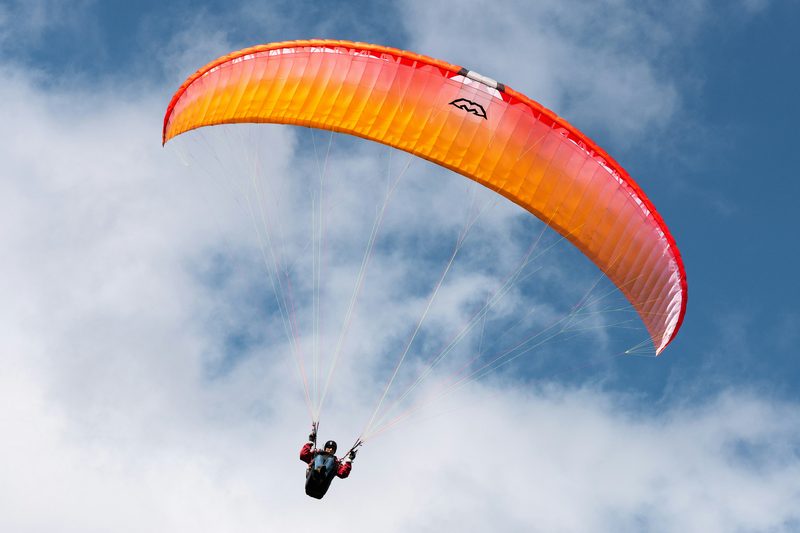
Picture this: You're cruising along at 45 kilometers per hour, scanning the sky for cu's, watching other pilots, trying to read the terrain below. Suddenly, beep beep beep. Your vario comes alive. Thermal! You crank into a turn and start climbing.
Perfect timing, right?
Wrong.
By the time your vario beeped, you'd already been inside that thermal for nearly two and a half seconds. At 45 kilometers per hour, that's about 30 meters. In many weak thermals, the core is only 50 meters wide. You just flew more than halfway through it before you even knew it was there.
Your expensive, total-energy-compensated, bluetooth-enabled variometer just cost you the core.
The Problem Nobody Wants to Talk About
Here's the uncomfortable truth that the variometer industry doesn't advertise: every single variometer, from the cheapest beeping box to the most sophisticated electronic instrument, works the same fundamental way. They all measure vertical speed by detecting altitude change.
And that means they're all backward-looking.
Think about what has to happen before your vario can tell you about lift. First, the thermal has to actually make your entire aircraft system start moving upward. Not just touching your wing, actually accelerating all hundred-plus kilograms of you and your wing vertically. Then that motion has to overcome your sink rate. Then it has to persist long enough to be measurable above the noise of turbulence and gusts. Then the signal has to be processed and filtered to make sure it's real.
Only after all of that does your vario beep.
The physics is brutal. In real-world conditions, we're talking one and a half to three seconds of lag time. And that's for strong thermals. For weak thermals, it's worse.
What Actually Happens When You Hit a Thermal
Let me break down the timeline of what's really happening when you encounter a thermal at cruise speed.
In a weak thermal with a 50-meter core, you've overshot it by more than half. The best part of the lift is now behind you.
"But I Have Total Energy Compensation!"
I hear this a lot. "My vario has total energy compensation, so it's faster."
And yeah, total energy compensation is brilliant. It's elegant engineering that removes false signals from speed changes. When you pull up and briefly climb without actually being in lift, TE compensation knows to ignore it. When you speed up and briefly sink, it knows that's not real sink.
It's genuinely clever stuff and it absolutely makes varios better.
Total Energy = Kinetic Energy + Potential Energy
A TE vario measures: KE + PE = constant in still air. This eliminates false signals caused by speed changes — pulling up converts kinetic energy to potential energy, but the vario knows this doesn't indicate real lift. The filtering is sophisticated and effective.
However, TE compensation is a filtering tool. It cannot reduce the fundamental lag: you still need bulk vertical motion before the vario generates any signal at all. It's faster at confirming real thermals, but it can't make the signal arrive before the motion begins.
But here's the thing: total energy compensation doesn't change the fundamental limitation. You still need bulk vertical motion before you get a signal. TE just helps filter out the noise. It doesn't make the signal arrive faster.
The lag isn't a design flaw. It's physics. Your variometer has to wait for motion. And in weak thermals, waiting costs you the core.
Why Two Seconds Matters More Than You Think
You might be thinking, "Okay, two seconds, big deal. I can work with that."
Can you though?
Let's talk about what two seconds means at typical flying speeds. At 45 kilometers per hour, you travel 25 meters in two seconds. At 50 kilometers per hour, it's 28 meters.
Now let's talk about thermal cores. A strong thermal might have a core 200 meters across. Plenty of room to work with, even with a delayed vario. Miss the center by 30 meters? No big deal, you're still in good lift.
But a weak thermal, the kind you're desperately trying to work when you're low and the day is dying? Those cores can be 50 to 80 meters across. Miss the center by 30 meters and you're on the edge. You're in marginal lift, maybe one meter per second instead of the two meters per second you could be getting. Or worse, you drift out entirely while you're still trying to figure out where the core actually was.
Here's the really frustrating part: by the time your vario beeps and you turn, you've overshot. So you widen your circle, trying to find the sweet spot again. But now you're drifting in the wind, and the thermal is moving, and you're guessing, and before you know it you're back in sink wondering where that thermal went.
It didn't go anywhere. You flew through it before you knew where it was.
The Real-World Difference
We've been testing spatial detection with pilots in actual conditions. Not simulations. Not theory. Real flights, real thermals, real marginal conditions.

In weak thermals, one and a half to two meters per second, the kind that separate successful flights from frustrating ones, our beta pilots using spatial detection are gaining an average of 47% more altitude per thermal compared to using traditional varios alone.
Forty-seven percent.
That's not because the thermals were any different. It's because they detected them earlier and centered them faster. They spent more time in the core and less time wandering around the edges trying to figure out where the core was.
Detection Timeline Comparison
At cruise speed, spatial detection provides an advance warning of 1.5–2.5 seconds — the difference between nailing the core and overshooting it entirely.
How Spatial Detection Changes the Game
Instead of waiting for your entire aircraft to start moving vertically, we measure the pressure difference across your wing span. The moment your right cell enters a thermal, the pressure in that cell changes. We detect that change immediately.
The detection happens in a tenth of a second or less. Before your left cell has even entered the thermal. Way, way before you've started climbing. Long before your traditional vario has any idea what's happening.
The advance warning? One and a half to two and a half seconds depending on thermal strength and your speed.
At cruise speed, that's 20 to 30 meters. In a weak thermal with a 50-meter core, that's the difference between nailing the center and overshooting entirely.
It's not just earlier detection. It's actionable earlier detection. Because we're measuring left versus right pressure, we can also tell you which way the core is. Right wing hit first? Core is to the right. Left wing hit first? Core is to the left.
No more guessing. No more widening circles trying to find it. You know, immediately, which way to turn.
Temporal Detection (Vario)
Spatial Detection (ParaBaro)
The Real-World Results
In late-afternoon conditions, when thermals were dying and everyone was scratching, pilots with early detection were 50% more likely to successfully climb back out compared to relying only on traditional varios. These aren't small numbers. This is the difference between making it home and landing out. Between completing your task and falling short. Between topping out and walking back down.
Why This Hasn't Existed Before
The technology to detect pressure differences this small simply didn't exist until recently. The sensors weren't good enough. They were too noisy, too big, too power-hungry, too expensive.
Modern MEMS pressure sensors changed that. The same technology that's in your smartphone's barometer can now detect pressure changes smaller than one Pascal. That's less than the weight of a postage stamp spread over your entire hand.
And processing power. The algorithms that interpret these tiny pressure changes and distinguish real thermals from gusts and turbulence, those algorithms require modern microcontrollers that are incredibly powerful yet tiny and power-efficient.
Five years ago, this wouldn't have been possible. Ten years ago, forget it.
But now? Now we can put sophisticated detection systems in devices smaller and lighter than your current vario, running for a full day on a battery the size of your thumb.
The technology caught up to what's physically possible.
The Bottom Line
Your variometer isn't bad. It's doing exactly what it was designed to do. The engineers who designed it did brilliant work within the constraints of temporal detection.
But it's fundamentally limited by physics. It has to wait for motion. And waiting for motion means waiting for time that you don't have in weak conditions.
Spatial detection doesn't replace your vario. It supplements it. It gives you information earlier, when you need it most, when the thermals are weak and the cores are small and every second counts.
That beep you hear from your traditional vario? It's still valuable confirmation. But imagine hearing a different beep two seconds earlier, telling you the thermal is there and which way to turn before you've flown through the best part of it.
That's not science fiction. That's what we're building — and our beta pilots are already testing it in real conditions.
Your vario will always be late. But it doesn't have to be your only source of information.
Ready to Get Ahead of Your Vario?
Join our beta programme and test spatial thermal detection in real conditions. See the difference early detection makes before your competitors do.
Explore ParaBaro BetaNext in this series: The Lost Art of Scratching — practical techniques for making weak thermals work, and how earlier detection changes the game when you're low and the day is dying.