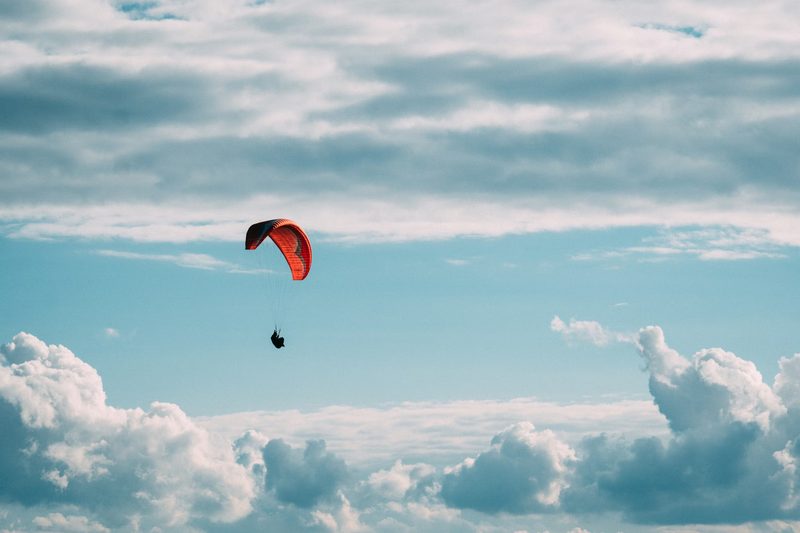
Last weekend I watched a pilot scratch his way back to cloudbase in what he kept calling "weak lift." His vario was barely chirping, maybe one and a half meters per second. He looked frustrated, working hard to stay centered, cranking the wing over in tight circles.
"Man, this thermal is tiny," he said after landing.
I didn't have the heart to tell him that the "tiny" thermal he'd just climbed in probably weighed more than a thousand tons.
You Have No Idea How Big Thermals Actually Are
We talk about thermals like they're these modest little columns of air. We say things like "I found a small thermal" or "there was this narrow core." And I get it, when you're circling in one, desperately trying not to fall out of it, it feels small and fragile.
But here's the truth that'll blow your mind: that "small" thermal you worked on your last flight? The one that felt like you could barely fit inside it? It was probably 300 to 500 meters across. That's wider than the Eiffel Tower is tall. And it extended upward for a thousand meters or more.
The air inside that thermal, just the air you were circling in, weighed somewhere between 400 and 1,200 tons. For context, that's roughly the weight of four to twelve fully loaded commercial airliners. Except instead of aluminum and jet fuel, it's all air. Hot air. Rising air. Rotating air.
And those strong thermals, the ones that take you to cloudbase at four or five meters per second? Those monsters can be a kilometer across and weigh 300,000 tons. That's three nuclear aircraft carriers. Made of air. Spinning like a giant invisible tornado lying on its side.
The mass of a strong thermal — equivalent to three aircraft carriers
Your paraglider, meanwhile, is twelve meters wide. You're literally a speck inside these things.
The Scale of What You're Flying In
Weak Thermals
Strong Thermals
Why This Matters (Beyond Just Being Cool)
Now here's where this gets interesting for anyone who cares about flying safely and efficiently.
Your wing is twelve meters across. A typical thermal is anywhere from 300 to 1,000 meters across. Do the math and you're one percent the size of what you're trying to detect. Maybe less.
This means something crucial: when you fly into a thermal, you don't enter it all at once. It's physically impossible. One wingtip crosses the boundary first. Then, maybe a second or two later, the other wingtip crosses. During that time, one side of your wing is in rising air and the other side is in regular air.
For a full one to two seconds, your wing is experiencing two completely different air masses. One side is getting lifted, the other isn't. The pressure in your cells on one side is different from the pressure on the other side — and that difference can be measured before your variometer even knows you're in lift.
Traditional varios are waiting for your entire aircraft to start moving upward. But by the time that happens, you've been inside the thermal for nearly three seconds already. And at cruising speed, three seconds means you've traveled almost 40 meters. In a weak thermal with a core that's only 50 meters wide, you might have already flown right through the best part before your vario even beeped.
This is why understanding thermal size isn't just interesting trivia. It's the key to unlocking better detection technology.
The Daily Rhythm Nobody Told You About
Here's something else most pilots don't think about: thermals aren't static. They're not just sitting there waiting for you all day. They follow a rhythm as predictable as the sunrise.
Understanding this rhythm changes how you plan flights. That weak lift at seven in the morning? Don't give up, it's about to get much better. Struggling at five in the afternoon? I hate to tell you this, but it's only going downhill from here. You might want to start thinking about where you're going to land.
The Vortex Ring (Or: Why Centering Matters)
Now let's talk about what's actually happening inside these giants.
Thermals aren't smooth columns of air gently rising. They're vortex rings. Think about blowing a smoke ring. The smoke rotates in a donut shape, down through the center, up around the outside, then back down through the center again. Thermals work exactly the same way, just invisible and the size of a city block.
The strongest lift is in the core, right in the middle of the rising side of the vortex. This is often two or three times stronger than the average. This is what experienced pilots mean when they talk about "riding the fountain." You're literally surfing the upward-rotating part of a giant atmospheric vortex.
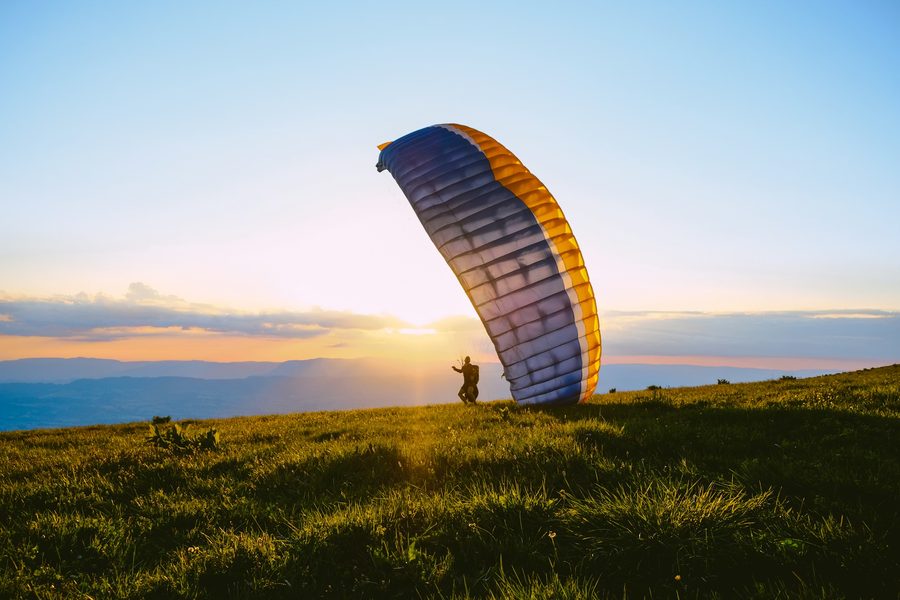
Around the edges, where the thermal is mixing with the surrounding air, things get turbulent and chaotic. You get lift, you get sink, you get shear. It's rough. This is why finding the core and staying centered isn't just about climbing faster, it's about having a smoother, safer flight.
Between thermals, there's gentle downward flow. The air has to go somewhere, right? What goes up must come down, and it comes down in the spaces between the thermals. This is why XC flying is all about connecting the dots, thermal to thermal, minimizing time in the sink.
Calculating Thermal Mass: The Physics
A thermal's mass depends on a simple relationship: air density × volume = mass. Air has a density of about 1.225 kg/m³ at sea level. Most thermals form as cylinders or vortex rings, so we can model them with basic geometry: π × radius² × height.
Mass = ρ × π × r² × hFor example: a modest thermal with a radius of 250 meters and height of 1,000 meters equals about 240 million cubic meters of air. At 1.225 kg/m³, that's roughly 240,000 tons — enough mass to sink a small island, and you're circling inside it.
Stronger thermals, with larger radii (up to 500m) and greater heights (2,000m), can exceed 300,000 tons. Weaker thermals might be only 300–500m across and 800m tall, giving them 200–800 tons of mass.
Weak Versus Strong: A Different Animal Entirely
I need to tell you something that took me years to really understand: weak thermals and strong thermals aren't just different magnitudes of the same thing. They're fundamentally different animals.
Strong thermals, anything over three meters per second, are forgiving. The cores are wide. The transitions are gradual. Your vario screams at you from a hundred meters away. You can drift to the edge and still be climbing. They're easy to find, easy to center, and honestly, kind of hard to screw up.
Weak thermals, anything under two meters per second, are unforgiving little bastards. The cores are narrow, sometimes only 50 meters across. The boundaries are sharp with high shear. They're hard to distinguish from regular turbulence. They're easy to fall out of. And your vario often doesn't even register them until you're already halfway through.
You might be thinking, "So what? I only fly in good conditions anyway."
But here's the thing. What about spring, when the thermals are notoriously weak but you're itching to fly after a long winter? What about late afternoon when the day is dying but you're still 30 kilometers from home? What about those marginal days when weak thermals are the difference between staying up and landing out? What about competition, where every meter counts?
Weak thermal detection isn't just a nice-to-have. For many of us, for many flights, it's the difference between success and walking back to retrieve the car.
The Bottom Line That Changes How You Think
You're not circling in some abstract concept called "lift." You're dancing with a rotating atmospheric vortex that formed because a parking lot heated up differently than the grass field next door. That vortex weighs hundreds or thousands of tons. It follows precise physical laws. It has a predictable lifecycle. And critically, it's so much bigger than you that your wing enters it asymmetrically, creating signals that can be detected earlier than we've ever been able to detect before.
This isn't just cool physics. This is the foundation for technology that could change how we fly. Because once you understand that thermals are giant and your wing is tiny, you realize that traditional detection methods have been asking the wrong question.
A better question is: "Is part of my wing experiencing different air than the other part?"
One question requires you to already be moving. The other can be answered the instant you touch the thermal boundary.
One takes three seconds. The other takes a tenth of a second.
That difference, that two or three seconds of advance warning, that's everything. That's the difference between nailing the core and overshooting it. That's the difference between detecting turbulence before it hits you versus reacting after you're already in trouble.
Next time you're thermal flying, take a moment to really think about what you're in. You're not just in "lift." You're inside a thousand-ton rotating mass of air that's bigger than most buildings, following the same physics that creates hurricanes and tornadoes, just on a smaller, friendlier scale.
It's humbling. It's awesome in the original sense of the word. And understanding it might just make you a better, safer pilot.
Ready to Detect Thermals Earlier?
Learn how Aviometrics is using pressure sensing to detect thermals before they lift your vario — helping you find lift faster and fly safer.
Join the Beta ProgrammeNext in this series: Your Vario Is Lying To You — why even the best variometer in the world is always late to the party, and what we can do about it.