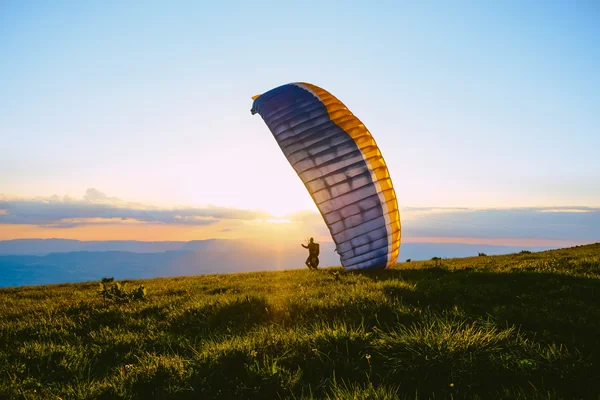
It's 6 PM, you're low, and that weak beep from your vario is the only thing between you and landing out 30 kilometers from home. Here's how to make weak thermals work for you.
I was at a flying site in the Alps last summer, watching two pilots deal with the same dying conditions. It was 6:30 in the evening. The strong thermals from midday were long gone. What was left were these pathetic little wisps of lift, maybe one and a half meters per second on a good cycle.
The first pilot, let's call him Mike, launched at about 500 meters above the valley floor. Within ten minutes he was on the ground, frustrated and muttering about how the conditions were "impossible."
The second pilot, Sarah, launched right after him. Same conditions. Same altitude. Forty minutes later she was at 1,200 meters, grinning ear to ear, watching the sunset from cloudbase while the rest of us packed up below.
Same conditions. Completely different results.
The difference wasn't talent or magic. It was understanding weak thermals and having the tools to work them effectively.
What Makes Weak Thermals So Hard
Let's define what we're talking about here. Meteorologists and soaring pilots generally agree on these categories:
Minimum soarable is around one and a half meters per second. Good conditions are two meters per second or more. Excellent conditions are anything over two and a half meters per second.
But here's the brutal reality: anything under two meters per second is challenging, and here's why.
Your paraglider's sink rate at minimum sink speed is about one meter per second. So in a one and a half meter per second thermal, you're only actually climbing at half a meter per second net. To gain 100 meters takes you over three minutes. During those three minutes, if there's even a ten kilometer per hour wind, you've drifted 550 meters. Good luck staying in a thermal that's only 50 to 80 meters wide.
Compare that to a nice three meter per second thermal. Net climb rate is two meters per second. You gain 100 meters in less than a minute. You drift 140 meters. The thermal is probably 300 meters wide. You've got room to work.
Weak thermals aren't just slower, they're smaller. They're more turbulent at the edges. They're shorter-lived. They're harder to distinguish from regular atmospheric noise. One small mistake and you're out of the thermal entirely, back in sink, and probably not finding it again.
Why Your Vario Makes Weak Lift Even Harder
In strong conditions, your vario is your friend. It screams at you from a hundred meters away. The signal is clear and obvious. Even if there's a little lag in detection, the cores are so wide and forgiving that it doesn't matter.
In weak conditions, your vario becomes part of the problem.
First, there's the signal-to-noise issue. Weak lift produces a weak signal, maybe one and a half meters per second. But turbulence, gusts, and atmospheric noise are still producing half a meter per second of random variation. Your vario is trying to distinguish a signal that's only three times stronger than the noise. That's hard.
So sometimes it beeps when there's no thermal, just a gust. And sometimes it doesn't beep when there IS a thermal because it's not sure yet. False positives and false negatives, constantly.
Second, there's the detection lag. In strong thermals, your vario might beep one and a half seconds after you enter. In weak thermals, it can take two and a half or even three seconds because it needs more data to be confident.
By the time it beeps, you've traveled 25 to 35 meters at cruise speed. The core might only be 50 meters wide total. You're already past the sweet spot by the time you know it was there.
This is why scratching feels so frustrating. You're not bad at finding thermals. The thermals are there. Your instrument just can't tell you about them in time to do anything useful with the information.
The Techniques That Actually Work
Okay, enough complaining about the problem. Let's talk about solutions. These techniques work regardless of what instrument you're flying with.
First: Fly slow. And I mean really slow. Not "a bit of brake," I mean minimum sink speed. For most EN-B wings, that's about 30 centimeters of brake. For EN-C and D wings, maybe 25 centimeters. You need to know this number from an SIV course, not guess it.
Why does this matter so much? Because minimum sink is typically 0.9 to one meter per second. Normal cruise is more like 1.2 to 1.5 meters per second. In one and a half meter per second lift, minimum sink gives you 0.5 to 0.6 meters per second net climb. Normal cruise gives you zero to 0.3 meters per second. You might literally not climb at all.
The danger here is stalling or spinning if you use too much brake, especially in a turn. So you need to know your wing and you need to be ready to release brake instantly if you feel the wing pitch back. This is not the time to learn this stuff. Practice in safe conditions first.
Second: Turn on the first indication of lift. This sounds obvious but watch pilots in weak conditions and most of them turn AFTER they've passed through the lift. They fly through the thermal, encounter sink on the other side, then turn around to search for what they just flew past.
In weak conditions, you turn on the first beep. Not the strongest beep. The first beep. Even if it's inconsistent. Even if you're not sure. Turn immediately. You can always straighten out if it was nothing, but if you wait, you've lost it.
Third: Stay upwind. Thermals drift with the wind and the strongest part of the thermal tends to lag upwind of the circulation. When you lose the thermal, don't drift downwind with it. Push upwind. Widen your circle if you need to, but bias your search upwind.
I can't tell you how many times I've watched pilots drift downwind of a thermal, frantically searching for it, while it was right there 50 meters upwind the whole time.
Fourth: Read the cycle. Even weak thermals pulse and cycle. Strong surge for two minutes, weakening for two minutes, dying for a minute, dead period for another minute or two, then a new pulse begins.
When you feel the thermal weakening, don't immediately abandon it. Wait. Give it a couple of minutes. The next pulse might be starting. If it doesn't come, then leave. But don't give up on the first sign of weakness.
Fifth: Small circles, smooth inputs. Tighter circles mean more time in the core, but they also mean higher sink rate. You need to find the sweet spot. Usually that's about 30 to 45 degrees of bank for EN-B wings in weak lift. Steep enough to stay tight, not so steep you're sinking too fast.
And smooth. Jerky control inputs increase your sink rate and make it harder to feel what the air is doing. Smooth weight shift, smooth brake inputs, smooth transitions.
The Real Problem: Information Lag
But here's the thing. You can have perfect technique and still struggle in weak conditions if you don't have good information fast enough.
Think about what you need to successfully work a weak thermal. You need to know it's there. You need to know where the core is. You need to turn at the right time in the right direction. And you need to do all of this while the thermal is small and your margin for error is tiny.
Traditional varios give you "it's there" information, eventually, after you're already halfway through it. They don't give you "where is the core" information. They don't give you directional information. You're guessing based on which part of your circle felt best, which in weak and turbulent conditions is almost impossible to judge accurately.
This is where technology can make a real difference.
What Better Detection Looks Like in Practice
Imagine you're flying along in those same dying evening conditions. One and a half meters per second thermals, narrow cores, scratching to stay up.
With a traditional vario, you might hear a weak beep, turn, and find yourself in sink. Was that a thermal or just a gust? Which way was the core? You widen your circle, searching. By the time you figure it out, you've lost altitude and drifted.
Now imagine instead: you're flying along and you hear a distinctive audio cue. Not your normal vario beep, something different. And it's telling you not just "thermal detected" but "thermal to your right."
You turn right immediately. Half a second later your traditional vario confirms with its normal beep. But you're already turning, already positioning yourself for the core. By the time you complete the turn, you're in the best part of the thermal, climbing steadily.
That's what early detection with directional information gives you. It's not magic. It's just better information, delivered faster, when you need it most.
The results: Pilots testing this technology are reporting 40 to 50 percent more altitude gained per thermal in weak conditions. Not because they're flying better, but because they're centering faster and spending more time in the core instead of wandering around looking for it.
When Scratching Actually Matters
You might be thinking, "I only fly in good conditions anyway. I don't need to get better at scratching."
Fair enough. But consider:
Spring flying, when you're itching to get back in the air after a long winter but the thermals are notoriously weak. Do you skip those days or do you work them?
Late afternoon, when you're on an XC flight and the day is dying but you're still 40 kilometers from home. Do you land out or do you scratch your way back?
Marginal days when the forecast is questionable but some pilots are staying up and some aren't. Are you the one who makes it work or the one who walks back down?
Competition flying when every meter counts and the difference between first place and tenth place is who could make weak thermals work when everyone else was landing.
Scratching isn't just a skill for desperate situations. It's a fundamental piloting skill that expands your flying envelope and makes you safer and more capable in a wider range of conditions.
The Data That Surprised Us
We've been testing early thermal detection with real pilots in real marginal conditions. Not simulations, not theory. Actual flights where people were actually scratching to stay up.
In weak thermals between one and a half and two meters per second, pilots using traditional varios had about a 45 percent success rate at climbing back to a safe altitude. More than half the time, they landed out.
Pilots with access to early spatial detection had a 68 percent success rate. That's a 50 percent improvement in outcomes.
+50%
Improvement in success rate when using early spatial detection in weak conditions
The average time spent scratching before either climbing out or giving up was eight and a half minutes with traditional varios versus six minutes with early detection. Two and a half minutes doesn't sound like much, but when you're low and the day is dying, it's the difference between making it and walking.
Most tellingly, the average altitude gain per weak thermal was 85 meters with traditional varios versus 125 meters with early detection. That 40-meter difference, repeated over multiple thermals, is the difference between staying airborne and landing out.
The Bottom Line
Scratching is hard. Weak thermals are unforgiving. Traditional detection methods leave you flying blind in exactly the conditions where you most need good information.
Perfect technique helps. Knowing your minimum sink speed, turning on the first indication of lift, staying upwind, reading the cycles, flying smooth circles. All of that absolutely helps.
But perfect technique with delayed information still puts you at a disadvantage. Better information earlier creates opportunities that don't exist with traditional detection.
The pilots who consistently make marginal conditions work aren't just more skilled, though skill obviously matters. They're making better decisions based on better information. They know where the thermals are sooner. They turn at the right time in the right direction. They spend more time climbing and less time searching.
The key insight: Technology doesn't replace skill. But it amplifies it. And in weak conditions, when your margin for error is tiny and every second counts, that amplification makes all the difference.
Next time you're low in dying conditions, watching your options disappear, remember: the thermal is probably there. The question is whether you can find it and center it before you run out of altitude.
Better detection won't make thermals stronger. But it might make the difference between climbing out and calling for a retrieve.
Coming next: The engineering deep-dive. How differential pressure detection actually works, what sensors we use, and why the pressure signal moves 2–3 seconds ahead of a barometric vario.
Want to see how early thermal detection works in practice? Join our beta program and help us validate this technology in real-world conditions. We're looking for experienced pilots who fly marginal conditions.