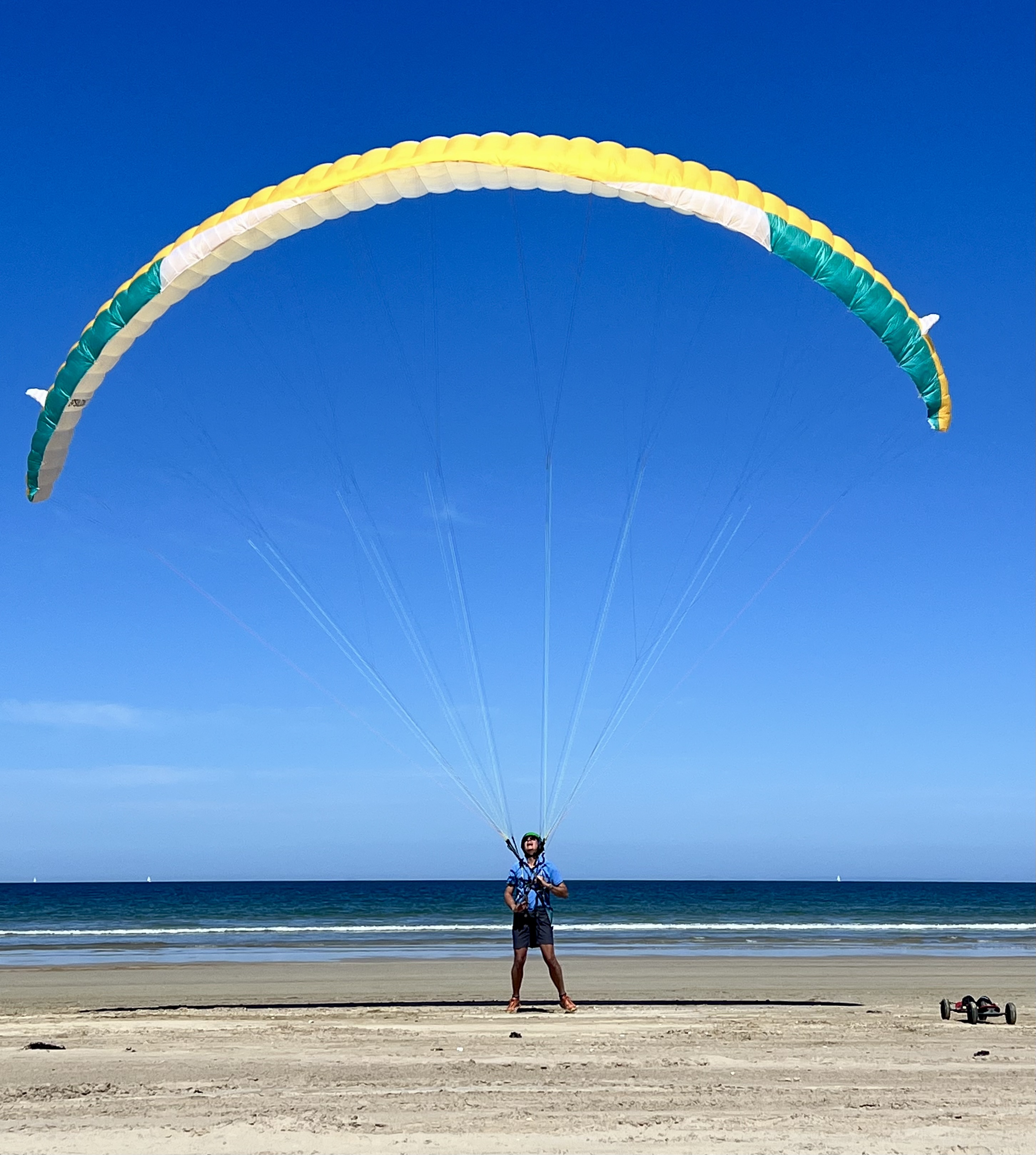
Every paraglider pilot knows the feeling. You lay the wing out, turn to face it, pull the A-risers — and in those two or three seconds before the canopy reaches overhead, you're flying completely blind. You can't see whether the left tip opened cleanly. You can't tell if there's a rosette forming in the centre cells. You're relying on hand tension, sound, and instinct — your body's best guess at what's happening above you.
But what if you could actually see inside the wing during those critical seconds? Not with a camera, but with something far more precise: the pressure of the air itself?
That question led us down a rabbit hole of atmospheric physics, ram-air aerodynamics, and sensor engineering. What we found surprised us: the physics of ground handling is not a simplified version of the physics of flight. It's a fundamentally different aerodynamic regime — one where conventional instruments are blind, but where differential pressure sensing has a unique and powerful advantage.
Your Wing Is a Pressure Vessel
A paraglider wing is a remarkable piece of engineering. Unlike a rigid aircraft wing that maintains its shape through structural materials, your canopy holds its airfoil shape entirely through internal air pressure. Air enters through the open cells at the leading edge, pressurises the internal chambers, and creates the curved shape that generates lift.
This internal pressure follows a simple but powerful relationship: it depends on the square of the airspeed. Double the airspeed, and you get four times the internal pressure. This quadratic sensitivity is why your wing feels rock-solid at full flight speed but soft and floppy when you're walking into a light breeze on the training hill.
The pressure inside each cell of your paraglider is governed by the ram-air equation: the internal pressure equals atmospheric pressure plus a fraction of the dynamic pressure of the oncoming air.
P_internal = P_ambient + C_p × ½ρV²Here, ρ is air density (about 1.225 kg/m³ at sea level), V is the airspeed, and C_p is the pressure coefficient — a number between roughly -1.5 and +1.0 that depends on where you measure on the airfoil. The key insight: pressure scales with the square of velocity.
The Ground Handling Gap
In flight, your wing moves through the air at 30–50 km/h. The internal pressures are high, the wing is stiff, and your GPS, variometer, and accelerometer all have plenty of signal to work with. This is the regime where conventional flight instruments were designed to operate.
On the ground, everything changes. Your wing sees only 10–25 km/h of airspeed — whatever the wind gives you, plus whatever you generate by walking or running. And because pressure scales with the square of speed, this isn't a modest reduction. It's dramatic.
Ground handling
In flight
This is the ground handling gap. Your GPS reads near-zero groundspeed. Your variometer reads nothing — you're not climbing or sinking. Your accelerometer shows 1g — you're standing still. Every conventional flight instrument is effectively blind. Yet your wing is fully aerodynamic, inflated, and responding to air pressure in real time.
At ground handling speeds, the wing exists in a state of marginal inflation — where a 2 m/s gust represents a 40% change in dynamic pressure. This sensitivity is precisely what makes pressure sensing so powerful.
Why "Marginal" Is Actually an Advantage
Here's the counterintuitive finding that surprised us most. You might think that low pressures mean weak signals and noisy data. The opposite is true.
During flight, the internal pressure is high and relatively stable. A 5 Pascal asymmetry between your left and right wing halves is noise — it's less than 10% of the baseline and could be caused by a minor brake input or a passing wisp of turbulence. The system has to work hard to distinguish real events from normal variation.
During ground handling, that same 5 Pascal asymmetry is a major signal. When your baseline pressure is only 15 Pa, a 5 Pa left-right difference means one side of your wing is inflated a third more than the other. Something is genuinely wrong — a tip hasn't opened, a cell is blocked, the inflation is happening asymmetrically. The signal-to-noise ratio for detecting inflation quality is actually higher on the ground than in flight.
This is physics working in our favour. The marginal inflation regime amplifies the relative significance of every pressure disturbance, making ground handling the ideal environment for pressure-based wing monitoring.
Anatomy of an Inflation
When you pull up your wing, a rapid and complex sequence of aerodynamic events unfolds in 2–5 seconds. Let's trace what the pressure sensors see.
Every one of these phases produces a distinctive pressure fingerprint. And every common ground handling mistake — pulling harder on one riser, not checking the lines, failing to step under the wing — leaves a measurable trace in the data.
What the Sensors Can See That You Can't
The real power of inflation monitoring isn't just recording what happened — it's detecting conditions that are invisible to the pilot in the moment. Here are the key scenarios:
Asymmetric inflation
One side of the wing opens 0.3 seconds before the other. In a reverse launch, you can't see this. With two pressure sensors (left and right), it's unmistakable: a sustained difference during the inflation ramp that exceeds the normal range for your wing class. An EN-A might normally show 5–10 Pa of asymmetry during inflation; an EN-D might show 10–25 Pa. Exceeding these ranges means something is wrong.
The invisible rosette
A rosette — where the leading edge tangles and the centre cells don't inflate properly — produces a very specific pressure signature: moderate average pressure (the outer cells are inflated) combined with extremely high asymmetry (the tangled section creates a persistent pressure void). This pattern is detectable within one second and could trigger an audio warning before the pilot even attempts to launch.
Gust vs. technique
When the wing surges or collapses during ground handling, was it the wind or the pilot? The answer is in the relationship between pressure variation and body movement. High pressure variance combined with low accelerometer activity means the wind changed — it's an external event. High pressure variance with high accelerometer activity means the pilot is the source of the disturbance. This distinction matters enormously for training feedback.
Different EN certification classes produce fundamentally different pressure signatures at ground handling speeds. An EN-A produces nearly twice the internal pressure of an EN-D at the same airspeed, because its lower aspect ratio and more closed cell structure retain pressure more efficiently. This means thresholds for "normal" and "abnormal" must be calibrated per wing class.
From Raw Physics to Pilot Feedback
Measuring pressure is just the beginning. The real challenge — and the real value — is turning those pressure traces into actionable feedback. Here's how ParaBaro approaches this translation.
Each inflation attempt is automatically segmented from the continuous data stream. The system detects when pressure rises above the "deflated" baseline (the wing is on the ground), tracks the inflation through its phases, and identifies when the wing reaches stable overhead position — or fails to get there.
For each inflation, the system computes a quality score based on four factors: how much pressure the wing achieved (did it fully pressurise?), how stable it was at the top (did it oscillate or hold steady?), how symmetric the inflation was (did both sides come up together?), and how smoothly the pressure ramped up (a clean pull versus a jerky one).
The remaining 10% comes from inflation smoothness — the absence of sudden jerks or stalls in the pressure ramp. Together, these produce a single 0–100 score for each inflation attempt. Over a training session, the system tracks how your scores change from the first attempt to the last, measuring within-session improvement.
The Training Tool That Doesn't Exist Yet
Here's what makes this genuinely new. Today, a paragliding student practices ground handling and gets feedback through two channels: their instructor's observations (subjective, intermittent, limited by viewing angle) and their own proprioception (which is exactly the skill they're trying to develop — a catch-22).
There is no quantitative record of a ground handling session. No way to compare Tuesday's performance to Saturday's. No way to prove to yourself that you're actually getting better, or to identify that your left-side inflations are consistently weaker than your right. No way for an instructor to review a student's solo practice.
Pressure monitoring changes this completely. Every session produces a structured record: number of inflations, success rate, average quality score, longest kiting bout, trend over the session. Across sessions, the system tracks skill progression — a number that goes up as you improve, with enough resolution to show the effect of a single focused practice session.
Ground handling is where every pilot spends time — beginners especially. An objective measurement tool for this foundational skill has never existed before.
Wind Estimation for Free
An unexpected bonus of continuous pressure monitoring during ground handling: it's a direct proxy for wind conditions. When the pilot is stationary and the wing is stable overhead, variations in internal pressure are almost entirely driven by wind gusts. The variance of the pressure signal over a few seconds gives you a real-time estimate of gust intensity that's measured at the wing, not at a windsock 50 metres away.
This means the system can provide a live "is it safe to keep practising?" assessment that's grounded in actual wing-level measurements. If gust-induced pressure variance exceeds a threshold for your wing class, the system can suggest it's time to put the wing away — before you learn that lesson the hard way.
What Comes Next
We're building ParaBaro's ground handling analysis module as part of our broader flight safety platform. The same differential pressure sensors that detect thermal entry 1.5 seconds before your variometer beeps — a capability we've published on extensively — turn out to be even more powerful for the humble but essential skill of ground handling.
The 50-pilot beta programme will include dedicated ground handling sessions alongside XC flights, generating the real-world data needed to calibrate per-wing-class thresholds and validate the inflation quality scoring. If you're interested in being part of this, we'd love to hear from you.
Because the next time you pull up your wing in a stiff crosswind, eyes fixed on the canopy rising above you, it would be nice to have a second opinion from someone who can actually measure what's happening inside those cells.
Join the ParaBaro Beta Programme
Be one of 50 pilots testing the world's first pressure-sensing paragliding instrument. Contribute to ground handling research while earning flight credits.
Apply for Beta Access